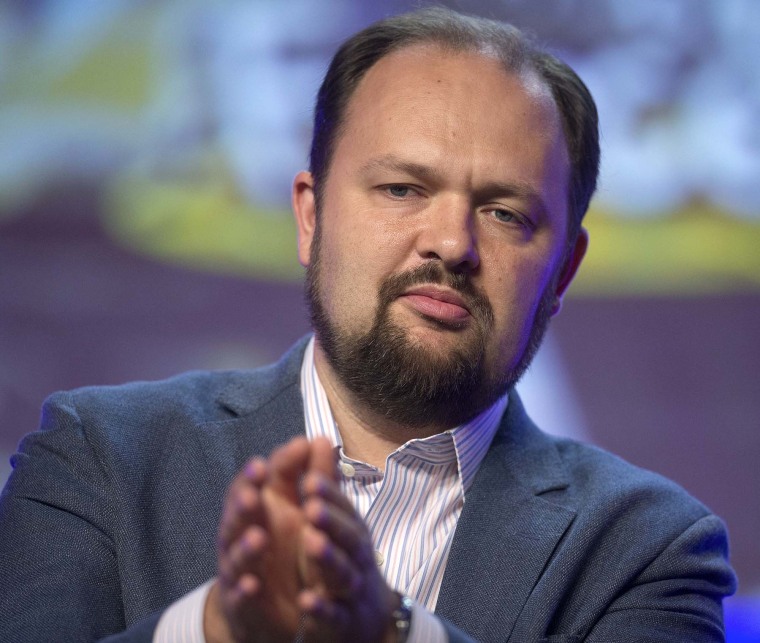
Two months after a major shake-up, CBS’ “60 Minutes” has hired a lineup of new correspondents and contributors in time for its 59th season, including Ross Douthat, a conservative opinion columnist at The New York Times, and Norah O’Donnell, former anchor of “CBS Evening News.”
The show’s new executive producer, Nick Bilton, announced the news in a staff memo Tuesday, shared on X. Joining Douthat and O’Donnell will be author Sebastian Junger, Trevor Phillips and Gianna Toboni. All will be contributors to the show.
The new journalists join current correspondents Lesley Stahl, Jon Wertheim and Bill Whitaker. Their hirings come two months after a shake-up at the storied program, led by the network’s new editor-in-chief, Bari Weiss.
Weiss installed Bilton, who has little substantive broadcast news experience, as executive producer, replacing Tanya Simon, who was let go after a 30-plus-year tenure with the show. Also let go were correspondents Sharyn Alfonsi and Cecilia Vega — and soon after, Scott Pelley, after a tense confrontation with his bosses over the changes.
In addition to the three dismissed, Anderson Cooper — whose primary job is at CNN — said earlier this year he was leaving of his own accord after two decades.
Weiss and Tom Cibrowski, the CBS News president, praised the new hires in an internal memo. “We couldn’t be more excited about this news,” the two said, welcoming the new additions. “Onward!”
Bilton called Douthat “one of the preeminent public intellectuals in America today, a thinker of uncommon rigor and a journalist of deep empathy.” The columnist has spent nearly two decades at the Times and is an author of numerous books.
Ross Douthat participates in FreedomFest 2018, an annual gathering of Libertarians.Brian Cahn / Zuma file
The producer called O’Donnell “a powerhouse.”
“You’ve seen her all over the network. She’s launched a new podcast. And you’ll see much more of her in our halls because Norah will be a correspondent on 60 Minutes.”
Bilton praised Junger for his nonfiction work “The Perfect Storm,” about a catastrophic 1991 storm. The book “landed with an electric charge in the world of reported nonfiction, defining an intense and intimate form of storytelling and establishing Sebastian as a generational talent,” Bilton said.
Toboni joins “60 Minutes” as a contributor and CBS News as a national correspondent. Previously a senior correspondent with VICE News and “VICE on HBO,” she comes to the program from CNN.
Calling her a journalist of “extraordinary range,” Bilton noted that Toboni has interviewed members of the Islamic State militant group, investigated cartel violence in Mexico and written a book on the death penalty.
Also serving as contributor will be Trevor Phillips, announced last month as the news division’s senior global affairs correspondent. Based in London, he is “one of the most respected and trusted voices in the United Kingdom for his ability to ask the toughest questions and hold anyone in power to account,” Bilton wrote in his memo.
From left, Sebastian Junger, Trevor Phillips and Gianna Toboni.Getty Images
Turmoil had raged at “60 Minutes” for more than a year before the May shake-up. Much of it came after President Donald Trump sued the show over its editing of a 2024 interview with then-Democratic presidential candidate Kamala Harris.
That became part of a broader shake-up at CBS News after Weiss was named to the new role of editor-in-chief by parent company Paramount late last year following David Ellison’s arrival as the network’s corporate leader.
This post appeared first on https://www.nbcnews.com
Farah Berent, a teacher in Michigan, used to learn about politics from channels like ABC, CBS and CNN. But that changed as she decided that coverage of the war in Gaza was irreparably biased.
“I couldn’t stand all the lies on the stations,″ she said, arguing that there wasn’t enough attention being paid to Palestinian suffering. “I started going to Instagram to get my news.”
Berent is among many progressive-minded Americans who have sworn off legacy media institutions. They’re turning to a widening mix of independent podcasts, social media accounts and digital news sites, part of an increasingly influential ecosystem that has boosted this year’s wave of antiestablishment, left-leaning candidates who may not have gotten as much attention otherwise.
Liberals remain more likely than conservatives to trust mainstream outlets, but the splintering echoes how conservatives skeptical of their party created a collection of insurgent news sites years ago. The shift has elevated individual commentators with opinions on the news, some of whom have proven influential in driving people’s votes.
Ryan Grim, a co-founder of Drop Site News and a veteran of online political debates, said progressive politicians have sought out his platform to reach voters. In a change from previous election cycles, “they have ways to get covered even if the mainstream just basically ignores them,” he said.
One of those candidates is Abdul El-Sayed, who is running for U.S. Senate in Michigan and faces the more moderate U.S. Rep. Haley Stevens in the Aug. 4 primary.
“I think in a lot of ways, where traditional media has been gatekeepers, we’re watching that gatekeeping function fall away,” El-Sayed said.
These changes have been on display this year in places like New York City, where a slate of progressive congressional candidates endorsed by Mayor Zohran Mamdani defeated establishment-backed candidates.
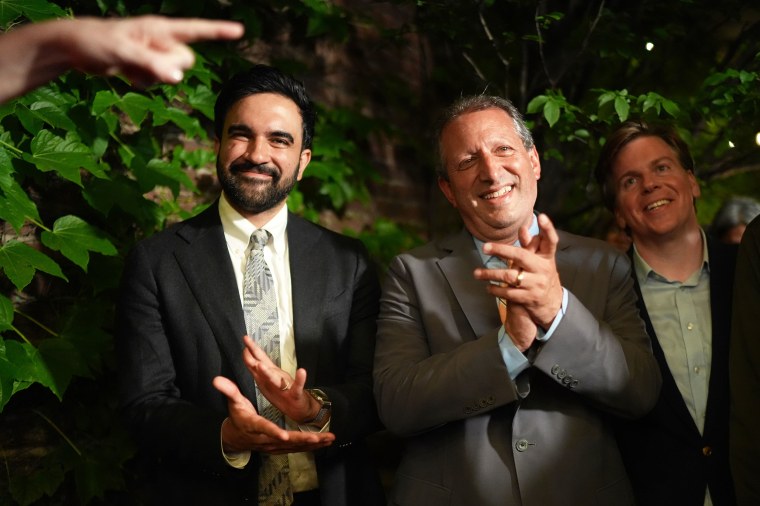
New York Mayor Zohran Mamdani and Democratic congressional candidate Brad Lander at an election night watch party in New York last month.Ryan Murphy / AP
Sara Hyler, a policy analyst in East Harlem, originally planned to support incumbent Rep. Adriano Espaillat in last month’s Democratic primary. But then Hyler started learning about progressive outsider Darializa Avila Chevalier through YouTube videos and podcasts, including from the liberal media company MeidasTouch.
“My actual beliefs are to the left of Democrats. I don’t want a moderate,” said Hyler, who ultimately voted for Avila Chevalier in hopes she could help nudge Congress toward progressive policies.
The rise of independent media has been part of a digital transformation that transcends politics, as chronically online Americans are turning toward news from social media and content creators. But it’s not just the popularity of smartphones driving that change.
“There’s a complete lack of trust in any and all institutions now,” said Mike Nellis, a Democratic consultant who hosts a podcast, writes a Substack and posts political analysis on social media. “That has led people to turn to individuals, and so now you’re picking your flavor of person to listen to.”
Among conservatives, faith in mainstream media and in the more moderate wing of the Republican Party faltered years ago, with the rise of the Tea Party movement paving the way for an alternative right-wing media ecosystem, including sites like the Daily Caller, Breitbart and The Blaze. Trump also tapped into a loose constellation of podcasts, including “The Joe Rogan Experience,” for his successful comeback campaign.
Reece Peck, a media culture professor at the College of Staten Island, said the left-wing version of that has happened slowly, beginning with the momentum of Sen. Bernie Sanders’ first presidential run in 2016. At the time, left-wing, antiestablishment YouTube accounts and podcasts like “The Young Turks” and “Chapo Trap House” were gaining attention but didn’t reach the majority of Democratic voters.
Now Democrats have realized their faith in institutions didn’t prevent Trump’s return.
“The ground has been made fertile for an anti-establishment media politics, where it just wasn’t quite there with the voter base in those previous cycles,” Peck said. Even older, moderate liberals, he said, have started to ″throw their hands in the air and look for alternatives.”
Hasan Piker answering questions and delivering a debriefing on daily politics for his Twitch stream in 2024.Brock Stoneham / NBC News
YouTube accounts like “Secular Talk” and “Breaking Points,” streamers like Hasan Piker and new digital journalism organizations like More Perfect Union and The Lever are among those that have seen their audiences multiply.
Grim said Drop Site has amassed 800,000 free and 60,000 paid subscribers since launching two years ago — more than he’d anticipated.
Saul Levin, a Michigan progressive organizer who recently started his own podcast about artificial intelligence data centers, said Trump’s attacks on the existing media landscape are part of the reason for that growth.
“The investigations and raids on numerous different journalists, the appointment of specifically aligned billionaires to lead various major news agencies, is very troubling,” he said. “Creators and new media outlets are stepping in and trying to fill gaps.”
The Michigan primary will be the latest test of the evolving media ecosystem, which El-Sayed, a longtime podcaster himself, has tried to harness. Various progressive outlets, creators and organizers have aggressively promoted his campaign.
El-Sayed said the rise of independent media has let voters compare news across different channels and notice biases, but he doesn’t turn down opportunities on legacy media, either.
“I go on Fox News, I go on podcasts, I Twitch stream, we have a YouTube channel,” he said.
Senate candidate Abdul El-Sayed in Southfield, Mich. on Monday.Robin Buckson / Pool Detroit News
Stevens, who received endorsements from outgoing incumbent Sen. Gary Peters, Michigan Gov. Gretchen Whitmer and Senate Democratic leader Chuck Schumer, has a more traditional approach. She’s also backed by the American Israel Public Affairs Committee, or AIPAC, and its affiliated groups, which have spent close to $30 million on the race.
Stevens’ campaign declined to comment for this story.
Reporting from progressive outlets has influenced how the race has unfolded. For example, Stevens parted ways with a campaign consultant when Drop Site revealed that she had also worked for tech company Palantir, which is controversial in liberal circles because of its government contracts involving immigration enforcement.
Democratic officials said Trump’s return to the White House has also revived interest in the party’s official channels. The Democratic National Committee’s relatively new digital media offering, a rapid-response clipping and messaging account with the handle @FactPostNews, has amassed more than 2 billion impressions on Threads, X, Facebook, Instagram and Bluesky in 2026 alone.
“I remember thinking to myself, there’s a chance that this flops and doesn’t get any traction,” said DNC Deputy Chief Mobilization Officer Paulina Mangubat. “It’s been really, really successful.”
At times, the mix of new voices on the left has erupted in public tensions.
Grim recently faced criticism for boosting failed Democratic candidate Graham Platner in Maine, and he was accused of trying to undermine the credibility of the sexual assault allegation that torpedoed Platner’s campaign. Grim said while he recognized people were angry, his reporting on the allegation was meant to share additional context.
“If we’re going to litigate allegations in the court of public opinion, we can’t pick and choose what details we want to share with the public out of a fear of how they’ll be received,” he said.
More recently, when Drop Site interviewed progressive U.S. Rep. Ro Khanna of California, one of its journalists pressed Khanna on whether Hamas was justified to attack Israeli soldiers on Oct. 7, 2023. Khanna refused to agree.
But Grim said those are the kinds of tough questions independent media are there to ask — and that American voters increasingly want to see their representatives in Congress answer.
“People want to see you being accountable to questions, and if they don’t agree with you, sometimes that’s fine,” he said. “I think the smarter politicians are starting to recognize that.”
This post appeared first on https://www.nbcnews.com
A major new bridge linking Canada and the U.S. at Detroit opened Monday to trucks, cars and other vehicles, the climax of a yearslong project that lately had been bruised a bit by international politics.
Descendants of Gordie Howe, the hockey legend whose name is on the bridge, were among the first to cross over the Detroit River, which separates the Motor City from Windsor, Ontario.
The span, which was built by Canada at a cost of $6.4 billion Canadian, now becomes a less-expensive alternative to the privately owned Ambassador Bridge, which had a monopoly on big trucks carrying goods worth billions between the two countries, especially in service to the auto industry.
“There are thousands of trucks that go over” daily, said Kevin Ketels, a business professor who teaches supply chain management at Wayne State University.
The family of Gordie Howe made the first official car crossing over the bridge Monday.Bill Pugliano / Getty Images
Freddie Garrett, 81, said he regularly watched construction “ever since they put the foundation in” back in 2018. So naturally he showed up at Delray Park in Detroit to see the first vehicles moving overhead.
“It was amazing to see how they did it,” Garrett said. “They put up one section at a time and then they met together in the middle. I’m sure it will be there longer than I’ll be around.”
Last week, Canada celebrated the Gordie Howe International Bridge with a ribbon-cutting ceremony in Windsor. U.S. and Michigan representatives were uninvited after President Donald Trump suddenly announced 50% tariffs on Canadian goods entering America.
More than 70% of Canada’s exports go to the U.S., making America its largest trade partner, and Detroit is the No. 1 port for truck traffic on the U.S.-Canada border, according to the U.S. Department of Transportation.
The span is 1.5 miles (2.4 kilometers) long and rises 151 feet (46 meters) above the river at its highest point. Pedestrians and bicyclists will be able to cross it for free, starting Aug. 5.
Howe is a Canadian icon known as “Mr. Hockey” who wore No. 9 while playing for the NHL’s Detroit Red Wings. He died in 2016.
Gordie Howe of the Detroit Red Wings warms up before a game in 1968.George Long / Sports Illustrated via Getty Images file
A recent agreement between Canada and the Trump administration says Canada will share some toll revenue with the U.S. government for 15 years. Michigan separately negotiated a share in 2012, but it won’t be paid until Canada’s costs are recovered, likely decades from now.
This post appeared first on https://www.nbcnews.com
Telemundo’s coverage of elite, global soccer won’t end after the World Cup final.
Telemundo has acquired the Spanish-language broadcast rights in the U.S. for all UEFA men’s club competitions for three seasons, beginning in 2027-28, the company announced Sunday.
The deal will bring live coverage of every match in the Champions League, the European tournament widely considered the world’s most prestigious club competition, across all of NBCUniversal’s broadcast, streaming and digital platforms, which include Peacock, Universo and Telemundo Deportes Ahora, its free, ad-supported television (FAST) channel.
The package will also include the Spanish-language rights to UEFA’s Europa League, Conference League and Super Cup competitions. (NBCUniversal is the parent company of NBC News and Telemundo.)
After the World Cup drew record audiences for Telemundo, the next question was how to continue building on such interest, said Cesar Conde, the chairman of NBCUniversal News Group. The Champions League, which is played annually and features many of the stars who became household names in the U.S. during the World Cup, was a natural answer.
“The World Cup didn’t really create an American soccer audience; it revealed it,” Conde said. “Premium soccer is just one of those truly global experiences that’s leapt out in the media ecosystem, and it brings people together from different backgrounds, different cultures, and different languages, and for something to be able to transcend all of that is very powerful in this current media ecosystem.”
Luis Fernández, Chairman of NBCUniversal Telemundo Enterprises, described Telemundo’s overarching strategy as being based on “live TV, live TV live TV,” and that within live television, soccer’s appeal is uniquely broad and compelling.
The company has invested heavily in the sport. On Thursday, Telemundo announced it will carry more than 100 matches per season from Germany’s Bundesliga. The company already carries the Spanish-language broadcasts for the Premier League, the Olympics, U.S. men’s and women’s national teams matches and Liga MX clubs Guadalajara, FC Juárez and Tigres UANL.
“This World Cup demonstrates that for our audience here in the states, (soccer) is very important,” Fernández said. “If you ask what is the most important franchise brand sports rights in football and soccer, there are only two names: World Cup for the national teams and Champions League for the most important clubs in the world.”
The deal comes at a time of surging viewership for soccer in the U.S.
Members of Paris Saint-Germain celebrate their UEFA Champions League victory in the final match against Arsenal FC in Budapest, earlier this year.Michael Regan / UEFA via Getty Images file
Through the semifinals, Telemundo’s coverage averaged a total audience of 6 million, an increase of 147% on the 2022 World Cup at the same stage of the tournament, according to the company.
A record audience of 50 million watched the U.S. match in the round of 16 of the World Cup across all broadcasters, making it the most-watched non-NFL sporting event this century, according to U.S. Soccer. Yet viewership continued to set records even after the U.S. team’s run was over. A total audience of 11.4 million watched Argentina’s win over England on Telemundo and Peacock, making it the most-watched semifinal ever in Spanish-language media history, according to the company. Spain’s win over France was watched by an audience of 9.8 million.
Notably, Telemundo says it reaches 96% of U.S. Hispanic TV households, the audience for its World Cup broadcasts hasn’t been limited to Spanish speakers. Though about 20% of the U.S. population is Hispanic, Telemundo’s broadcasts drew more than half of some matches’ total audience, including the round of 16 thriller between England and Mexico, according to Variety.
“An interesting dynamic that we particularly saw during this World Cup is that fans increasingly aren’t choosing to consume premium soccer based only on language,” Conde said. “They’re choosing it based on authenticity and the experience that they want to get out of the events. And so that’s what I think has also been a great insight and reminder for everyone in the marketplace, that authenticity in coverage of a global sporting event like soccer can transcend language, demographics, and cultures.”
Aleksander Čeferin, the UEFA President and chair of the board of UC3, which sells UEFA’s media rights, said in a statement that the “agreement with Telemundo reflects both the strength of our competitions and the passion of Spanish-speaking fans in the United States.”
This post appeared first on https://www.nbcnews.com
But while the team’s exploits on the field could not match the success of its supporters, pubs in England — some of which are struggling financially — have been boosted by the boon in beer sales from the team’s run to the World Cup semifinals.
England plays archrival Argentina in Atlanta on Wednesday, an 8 p.m. kickoff back home (3 p.m. ET) that will likely see fans flock to pubs across the country hoping to see their team make its first World Cup final in 60 years.
The profit made from the World Cup accounts for around 15% of the annual sales made by the Bread and Cheese pub in Thundersley, a small village around 40 miles east of London, owner Steve Haslam told NBC News in a telephone interview Tuesday.
He said he expected to make around 7,000 pounds to 9,000 pounds ($9,400 to $12,000) more than the average Wednesday, when England kicks off.
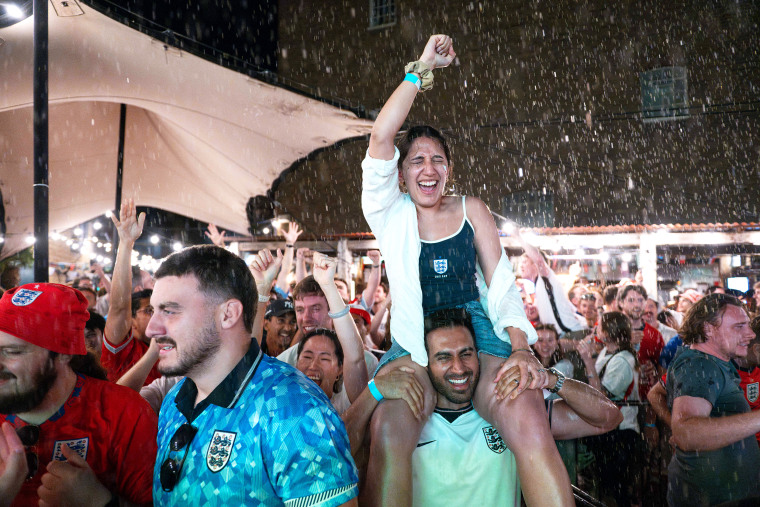
England fans in London celebrate the team’s quarterfinal win over Norway on Saturday. Thomas Krych / AP
And his pub is not alone. Around 5.5 million extra pints had been sold during group stages alone, according to UKHospitality, a trade body that represents the country’s hospitality and leisure sector.
Emma McClarkin, the CEO of the British Beer and Pub Association, said in an email Tuesday that it expected “Wednesday to be the most successful night of the tournament, with more than 6 million extra pints potentially sold,” around a 75% increase on the 8 million pints typically sold on an average Wednesday in July.
However, figures compiled by her organization and published in May show that 161 pubs across Britain closed between January and March, the equivalent of almost two a day.
Overall “margins are getting squeezed because it is a tough time for pubs right now,” said Haslam, the owner of the Bread and Cheese who is also director of Aim Pubs, a family business that owns eight pubs across the United Kingdom.
Having initially refused, the government did eventually relent and relax licensing laws for England’s second-round match against Mexico, allowing pubs to stay open until 5 a.m. local time.
An England fan in Liverpool on Saturday.Peter Powell / AFP via Getty Images
But both UKHospitality and the British Beer and Pub Association say lawmakers need to do more to protect the industry and blame high business rates and taxes as contributing factors to pub closures.
It’s a view shared by Ash Corbett-Collins, chairman of the Campaign for Real Ale or CAMRA.
The “government needs to fully recognize the contributions pubs make to the economy and social well-being of local communities,” he said. “We risk losing more and more pubs unless meaningful support is given.”
Fairer business rates and less tax on food and drink, including beer, would help out, he said. “The industry can’t rely on a sports tournament every four years to survive,” he added.
A spokesperson for Britain’s Treasury said the government was backing the hospitality industry by cutting taxes “on family attractions and kids meals this summer, reforming business rates, extending World Cup opening hours, and taking action on the cost of living to boost the sector.”
England’s Jude Bellingham celebrates after scoring against Norway.Patricia de Melo Moreira / AFP via Getty Images
The British government also announced in January that pubs and live music venues would be given a 15% discount on their business rates from April and not see increases for two years.
The British Beer and Pub Association said that this was “vital, but temporary” but a longer-term plan was required to “save pubs, jobs, and hearts of communities.”
And Haslam also said that the cut was largely ineffective and that he believed the government should revise the business and other taxes to help out.
“The great British pub is the heart of the country. People go to pubs to make memories. They’re social hubs doing so much good for the community,” he said. “Pubs have changed my life.”
This post appeared first on https://www.nbcnews.com
The satirical news site The Onion isn’t waiting to take possession of Infowars to launch a parody of Alex Jones ’ conspiracy platform.
More than a year after first trying to buy Infowars, The Onion on Thursday will debut a send-up under its own website with plans to give some of the revenue to families of the victims in the Sandy Hook Elementary School shooting.
The families have still received no money from Jones since courts ordered him to pay more than $1 billion for falsely calling the 2012 shooting a hoax.
The Onion will start by sending the families $100,000 from merchandise sales that combine the conspiracy empire’s brand with the The Onion’s logo in rainbow colors, according to CEO Ben Collins, whose company is still in court trying to take control of Infowars.
“Don’t give comedy writers a grudge for 18 months,” Collins said.
The parody will include a series of shows and other content under Infowars branding that spoof Jones’ aggressive mashup of conspiracies linking major news events, dubious scientific claims, attacks on people suffering in tragedies and sales of supplements and survival gear.
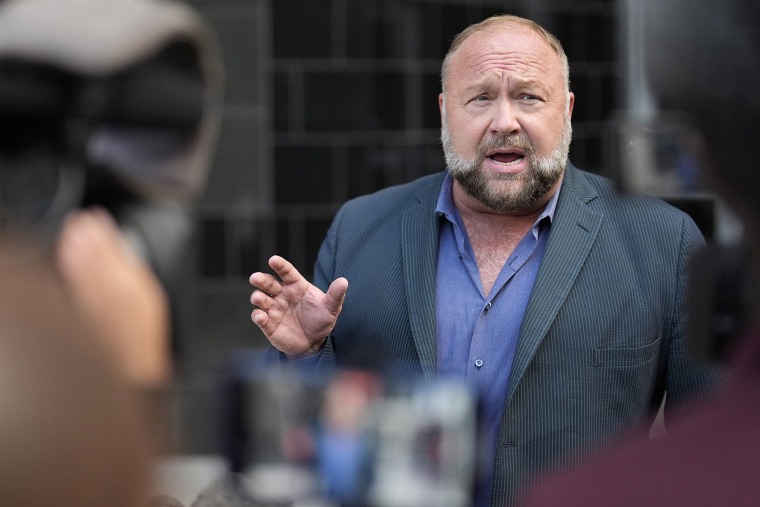
Alex Jones in Houston in 2024.David J. Phillip / AP file
Jones’ claims that the 2012 shooting that killed 20 first graders and six adults at Sandy Hook Elementary School in Connecticut is a hoax have no truth, but Jones continued to amplify them. His followers started to harass victims’ families, suggesting they were “crisis actors” and even making death threats.
Jones’ Infowars empire had 10 million visitors a month and generated more than $50 million in annual revenues at its peak, according to the company. But the $1.4 billion judgments in defamation cases in Connecticut and Texas, where Jones is based, forced him into bankruptcy and broke Infowars apart.
“All he’s been left with is an iPhone and a fancy microphone,” said Chris Mattei, an attorney for nine of the Sandy Hook families.
Jones has moved his show to a different website. An email sent to an address to request interviews went unanswered.
The families knew they could never stop Jones from getting his message out, and he has managed to avoid paying the judgment so far. But they could expose what he said and assure he can never profit again, Mattei said.
“Every dime Alex Jones makes from here until the end of eternity is going to be claimed by the families,” Mattei said.
The Onion stepped in when Collins saw Infowars’ assets were going to be sold at auction.
Collins spoke to Sandy Hook families, who said they were briefly skeptical, but then saw how The Onion’s staff could use the Infowars style and branding to take the moral high ground and make fun of the people who not only caused them so much pain but they felt also poisoned society.
Collins didn’t want to give away too much of the new stuff before it goes live Thursday.
But the new Infowars will maintain The Onion’s sharp satire sprinkled with shock value. Collins said there will be a section selling a penis flattening device, a fake “pro oxygen” supplement pill that the host claims can replace breathing, as well as an extended debate on how many Bozo the Clowns there are.
“It’s old-fashioned Infowars — using the tricks that they use to get people addicted to outrage and, I would say, addicted to anticipation, trying to find the thing that’s around the corner that’s going to save your life,” Collins said.
The Onion will keep chasing Jones’ property. Collins thinks they will soon get control of the Austin, Texas, studio Infowars once used.
Some families can’t wait for that day. Collins said that Robbie Parker, whose daughter died at Sandy Hook, plans to read his book about fighting Jones while dealing with so much grief in the place Jones once sat.
The families at first wanted Infowars shut down forever and Jones never heard from again. But they are now looking forward to seeing what The Onion has planned, attorney Mattei said.
“The idea that it could be turned to some social good. I think it’s even better,” Mattei said. “So, yeah, I think the families are both pleased and amused with what they’ve been able to achieve here.”
Paramount Skydance has accused Netflix of spearheading a “scorched-earth campaign to try and poison regulators and other stakeholders” against its $110 billion purchase of rival Hollywood studio Warner Bros. Discovery.
In a fiery letter to the Justice Department obtained by NBC News, Paramount Skydance Chief Legal Officer Makan Delrahim excoriated Netflix for what he called a “panic-level response” to the merger that illustrates “just how seriously Netflix takes Paramount as a scaled competitor.”
Paramount’s letter was sent to the Justice Department on Friday and first reported by Politico.
In response to a request for comment, a Netflix spokesperson said that “these claims from Paramount Skydance are absurd.”
“We walked away from this deal months ago and remain focused on our own business, not theirs,” the spokesperson added. “Ultimately, it’s up to the regulators to approve this deal and determine if it is in the best interest of the industry and all concerned.”
In the bidding war for Warner Bros. Discovery, Paramount Skydance triumphed over Netflix in late February. WBD shareholders approved the tie-up in late April.
Trump administration regulators are still reviewing the merger, which would unite two historic Hollywood studios and popular streaming platforms under the same corporate roof, reshaping the American entertainment industry.
The Justice Department did not immediately respond to a request for comment Tuesday.
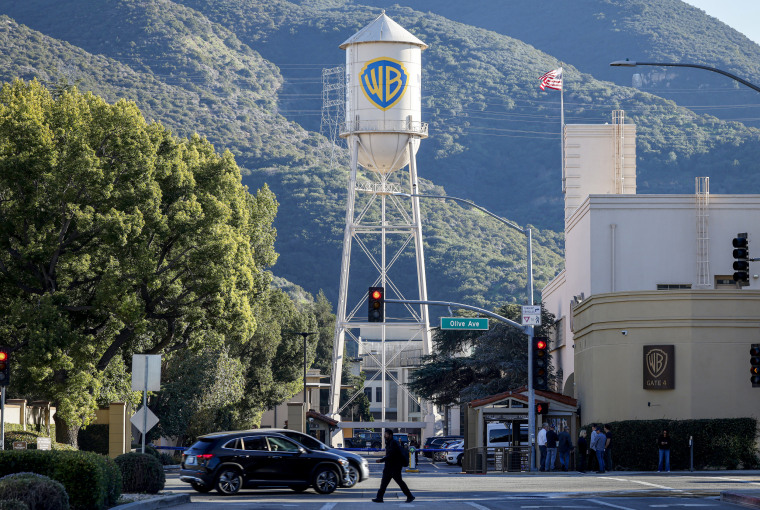
The water tower at Warner Bros. Studios in Burbank, Calif.Mario Tama / Getty Images file
Delrahim’s letter came in direct response to a March report sent to the Justice Department by the International Brotherhood of Teamsters, a labor union whose members, including drivers, work on film and television sets.
The Teamsters argued that Paramount’s acquisition of WBD “poses a direct threat” to workers. The union called on the Justice Department to block the deal unless “substantial and enforceable safeguards are put in place to increase domestic production and protect jobs.”
Delrahim’s letter flatly rejects that argument, with the legal executive writing that “organized labor will directly benefit from the new competitive energy and increased content investment that the combined firm will bring to the entertainment industry.”
The Teamsters did not immediately respond to a request for comment Tuesday.
Paramount’s letter accuses Netflix of launching a “broader proxy war” that includes trying to “persuade the Teamsters and other stakeholders that Disney’s acquisition of Fox had a negative impact on content production and labor opportunities.”
“Frankly,” Delrahim added, “Netflix’s ‘sky is falling’ narrative departs significantly from the ground-truth reality of what actually happened.”
The Walt Disney Co. took over 21st Century Fox’s entertainment assets in a $71.3 billion deal that closed in 2019.
Delrahim forcefully pushed back on the Teamsters’ contention that Disney’s takeover of the Fox assets hurt workers, writing in part that the Mouse House “unequivocally increased its spending on producing content overall since acquiring Fox.”
“Respectfully,” Delrahim wrote, “we do not understand why Netflix and its proxies are still pushing the Disney-Fox merger as a cautionary tale for studio combinations.”
The Teamsters is not the only group that has raised concerns about the Paramount-Warner transaction. In recent months, hundreds of A-list Hollywood actors, producers and directors have advocated against the deal.
“This transaction would further consolidate an already concentrated media landscape, reducing competition at a moment when our industries — and the audiences we serve — can least afford it,” more than 1,000 entertainment professionals said in an open letter published in April.
The prospective merger is also facing scrutiny from California Attorney General Rob Bonta, whose office is investigating the deal, and the United Kingdom’s antitrust authority, which formally announced a probe Tuesday.
Paramount Skydance CEO David Ellison has vowed to “honor the legacy of two iconic companies while accelerating our vision of building a next-generation media and entertainment company.” He has also publicly vowed to release at least 30 feature films a year in movie theaters.
Delrahim became Paramount Skydance’s chief legal officer last fall. He was previously the U.S. assistant attorney general for the Antitrust Division during President Donald Trump’s first term in the White House.
When the U.S. men’s national soccer team plays at home, its most loyal fans traditionally sit right behind a goal to cheer on the team or intimidate the opposition.
But when the Americans kick off a once-in-a-generation World Cup in Southern California next week, many of those die-hard supporters may be harder to hear because FIFA seated them in the “nose bleeds,” according to a major U.S. fan group.
“These are the worst tickets that I’ve ever seen out of the five World Cups I’ve been to,” American Outlaws President Brian Hexsel said in a phone interview.
FIFA’s World Cup ticketing rollout has faced withering criticism for months, particularly for its sky-high prices. There have also been allegations that some ticket buyers got worse seats than expected, sparking investigations in New York and New Jersey.
In the blowback, soccer’s global governing body announced a small allotment of $60 tickets for each of the tournament’s 104 matches.
FIFA didn’t immediately comment for this article.
Cristian Roldan, center, and the U.S. team applaud fans after their loss to Belgium at Mercedes-Benz Stadium on March 28.Kevin C. Cox / Getty Images
Participating member associations, including U.S. Soccer, would manage “the selection and distribution process,” said FIFA, which emphasized it was asking the associations to “ensure that these tickets are specifically allocated to loyal fans who are closely connected to their national teams.”
The American Outlaws are such fans. The organization says it has more than 200 chapters worldwide sharing one goal: cheering on U.S. Soccer’s teams. The group travels to matches with hand-painted banners, a giant American flag, drums and organized chants — all of it typically on display right behind the net.
But this summer, American Outlaws members with $60 tickets will be in upper decks at each of the team’s three group stage matches, Hexsel said. That seating arrangement means some of the most fervent fans will be physically farther from the pitch, potentially making it harder for players to hear their shouts.
Hexsel said U.S. Soccer told him Monday that the $60 seats will be in sections 302 through 310 for the team’s first match against Paraguay at Los Angeles County’s SoFi Stadium, sections 310 through 315 in Seattle’s Lumen Field for the second match against Australia and section 426 for the third match back at SoFi against Turkey — putting fans even higher than they’d be seated for the first match.
U.S. Soccer told NBC News the $60 tickets are in sections 306 through 310 for the Paraguay match, sections 302 through 304 for the Australia match and sections 426 through 431 against Turkey. It didn’t provide further comment.
When the tickets started landing in people’s accounts Monday night, “my phone just blew up,” Hexsel said. “Everybody was pissed.”
It’s not clear whether fan groups for the World Cup’s other competing countries have been affected in the same way.
Juan Felipe Garay, coordinator of Colombia’s biggest supporters’ group, Fiebre Amarilla, told NBC News the group doesn’t yet know where its $60 seats will be for Colombia’s matches.
But Hexsel said that without question, for the American die-hards, a World Cup in their own backyard now “does not feel like we are playing in the U.S.”
South Florida superfan Burak, who asked that his last name not be published for privacy, told NBC News on Monday night that a ticket in the “400s” showed up in his account for the third U.S. match.
Burak said he laughed with his wife about the situation and hadn’t expected better seats. He prefers being high up at a match when he’s trying to “read the play.” But, he said, watching is secondary to making an impact when you’re in the supporters’ section.
“If you’re up at nosebleed 400s, your reaction doesn’t even matter. No one’s going to hear, see or notice,” he wrote in a text message.
Another U.S. fan, Gabriel Miguel, said, “I thought it could be worse.”
Miguel scored $60 tickets to the opening U.S. match against Paraguay. He’ll be in section 308 and said he’s “mostly grateful” just to be in the building.
“I would love to have been down in the lower action, but I mean, 300s is perfectly fine, especially for that price.”
American supporter Logan Pedersen said, “We could have been higher up … not by far.”
Pedersen said in a phone interview that he got “the golden ticket,” getting to see the opening U.S. match at such a relatively low cost. He’s “just glad to be in the stadium,” but he also said FIFA’s ticketing “process has been a nightmare.”
“It’s still super disappointing from FIFA that they’re not at least designating a section for, you know, 500 fans from each team directly behind the goal. I think it’s a huge loss for the atmosphere that’s gonna go on in the stadium,” he said.
Hexsel said of the seating arrangements, “It just means we gotta bring more drums and more noise to show the team that … we still showed up.”
“FIFA could have just said: ‘Hey … it’s 300, it’s 200. Yeah, it’s a little bit more than what you paid in Qatar, but you guys have a block of seats where you’ve always had a block of seats,’ and people would have paid it.”
Burak said by text message: “I’m just glad I can at least go to some games with the supporter price. I accept my small guy status. If we had a strong community, I’d be all about boycotting the WC all together. But that’s not how people are, that will never happen. And Fifa is feeding off of that. They know someone will show up.”
Said Miguel: “I’m happy to be going, at least, and it’s more like memories than anything. Could it be better? Of course. But … they dropped the ball from the beginning with this. It’s … nothing surprising at this point.”
Growing up in South Florida, Jozy Altidore heard a lot of Spanish playing soccer with local kids and at home from his Dominican grandmother. As a teenager, he went to play for Villarreal, in the Castellón part of Spain, an area that isn’t that touristy. His coach and teammates mostly spoke Spanish. Along the way, Altidore picked up the language.
“A lot of people look at me like, ‘What? You speak Spanish?’” Altidore told NBC News.
It will come in handy this summer, when Altidore serves as a World Cup commentator for Telemundo, the games’ official Spanish-language network. Altidore has no experience in broadcasting, and he admits that his Spanish is just OK. But he saw the World Cup was coming to North America, and he didn’t want to be left on the sidelines.
“It’s the biggest, most historical World Cup we’ve had,” Altidore said. “For me, it was a good opportunity to stay involved, be a part of the World Cup.”
But what about his Spanish? “I can get by,” he said. “I thought, ‘What a cool challenge.’ I think you want to challenge yourself, in the things that you’re doing, always.”
Plus, he’ll get to see the Telemundo broadcast up close, the excitement of it, which is a stark contrast to the English-language telecasts, particularly the “goal” calls from the announcer Andrés Cantor. “I always wondered, how does he do that in one breath?” Altidore said. “This guy goes just the whole time. I can’t wait to see the legend in action.” (Telemundo and NBC News share a parent company, NBCUniversal.)
Altidore during the Gold Cup semifinal match between the U.S. and Jamaica in Nashville, Tenn., on July 3, 2019.Robin Alam / Icon Sportswire via Getty Images file
Altidore will be offering analysis and insight on Team USA’s games not far removed from his own time playing for the team. He is considered one of the best American players of the last two decades, a striker who scored 42 goals in 115 appearances. He helped the U.S. make it to the 2010 and 2014 World Cups, though he got injured during the latter tournament. He played with a few members of the 2026 roster, including Christian Pulisic.
Altidore told NBC News he has a rose-colored view of the current team. “I’m optimistic,” he said. “I’m bullish. I think this team can win the World Cup. I really do. I think they have the talent. And I’m so excited for them to get their flowers.”
Altidore understands how that sounds: Team USA? Winning the World Cup? But he pointed to past examples of host countries making deep runs in the tournament: South Korea reaching the semifinals in 2002, and Germany doing the same in 2006. Colombia also reached the quarterfinals in 2014, when the World Cup was held in neighboring Brazil.
With this World Cup being held on home soil, maybe “we’re able to push our team to a bit of a better performance than we have historically,” Altidore said.
He didn’t just mean the players — he meant the fans, too. “Can we show up in numbers in a way that, from the players’ arrival, they feel the emotion, they feel the enthusiasm, they feel the camaraderie?” Altidore said. “And we can push them on to play a little bit above themselves, to play a little bit above what we’ve seen already.”
You can sense his excitement. As a media member, Altidore will have to now learn to balance his rooting interests with offering clear-eyed analysis. “For me, it’s really getting behind these guys, applauding them for how far they’ve now taken the flag and where they’ve brought it,” he said. “But at the same time, it’s not all rainbows. You’ve got to be critical of guys, and you have to obviously critique their performances.”
Altidore was first introduced to soccer in 1994, the last time the U.S. hosted the World Cup, when he was just a young boy. His father recorded games on VHS tapes. He imagines lots of families will do the same this summer, three decades later, albeit with updated technology.
“They’re going to get exposed to soccer in a wonderful way for the first time, and it’s going to birth soccer players, it’s going to birth soccer fans, soccer enthusiasts,” Altidore said.
He’ll be doing his part, by showing his enthusiasm on the Telemundo broadcasts. “It’s more than just X’s and O’s in my opinion,” Altidore said. “This is a very good opportunity to continue growing the game for another 30, 40 years to come.”
The Trump administration has proposed new tariffs of up to 12.5% on imports from 60 economies after determining they had failed to curb trade in goods made with forced labor, an assertion that was rejected by its trading partners.
The proposal from the U.S. Trade Representative’s office, issued late on Tuesday, comes from a Section 301 unfair trade practices investigation designed to help rebuild U.S. President Donald Trump’s emergency tariffs, struck down by a U.S. Supreme Court decision in February.
Despite laws banning them, the products of forced labor are deeply embedded in supply chains around the world. But European lawmakers in particular bristle at the accusation that the region is less effective than the U.S. at curbing the trade in such goods, with one describing the U.S. findings as “utterly absurd.”
The USTR proposed 10% additional duties on imports from Canada, Ecuador, the European Union, Indonesia, Mexico, Pakistan, Argentina, Bangladesh, Cambodia, El Salvador, Guatemala, Malaysia, Taiwan and Britain. The USTR said all had plans or partial schemes in place.
Employees work on the spinning production line at a workshop of a textile factory in Xinjiang Uygur Autonomous Region of China on March 5.Bao Liangting / VCG via Getty Images file
The trade agency said it would impose additional duties of 12.5% on the remaining 45 countries that it investigated. These include China, India, Nigeria, Japan, South Korea, Vietnam, Australia and New Zealand.
“The failure of our most important trading partners to address the importation of goods made with forced labor is unacceptable,” U.S. Trade Representative Jamieson Greer said in a statement. “This creates a dynamic where American workers are forced to compete globally on an unlevel playing field.”
The USTR said it would accept public comments on the proposed tariffs and other remedies through July 6, with a public hearing scheduled for July 7.
The announcement comes ahead of the July 24 expiration of a 10% temporary tariff imposed by the Trump administration on Feb. 20, the day the Supreme Court struck down Trump’s tariffs under the International Emergency Economic Powers Act.
The European Commission said the tariffs were unjustified and reiterated its commitment to the trade deal sealed with Washington last year.
Bernd Lange, the chair of the European Parliament’s trade committee, which voted on Tuesday to accept that trade deal, said the new tariffs were expected, but said the results of the U.S. investigation were still “utterly absurd” given a 2024 E.U. law to ban imports of forced labor products.
“The impression is increasingly emerging that a tariff measure is sought first, and only then is a suitable legal justification found,” he said. However, he added that the key question would be whether the additional tariffs would exceed those agreed between both sides last July.
The U.S.’s largest trading partner, the European Union, agreed last July to accept tariffs of 15% on a broad range of its exports. In its report, the USTR said the E.U. measures came into force only in December 2027 and lacked key elements.
“We know there are ups and downs in what people say,” French Finance Minister Roland Lescure told reporters after a Cabinet meeting. “But the goal is to ratify the (trade) accord and stick to that.”
Britain said it was in regular talks with the United States and was taking action to tackle forced labor. It added that the preferential access to U.S. markets that it had negotiated for U.K. businesses remained in place.
Taiwan said it was “hopeful and confident” that the final results would reflect agreements already reached, securing relatively preferential treatment.
Beijing, facing 12.5% tariffs, said that it opposed all forms of unilateral tariffs and that there was no forced labor in China. India, confronted with the same rate, said it was engaged with Washington on the Section 301 proceedings, noting the proposed tariffs were not final.
On Monday, the USTR proposed a 25% duty on many Brazilian goods as a result of a Section 301 investigation into the country’s digital trade practices and preferential tariffs.
The trade agency is also expected to soon unveil the findings of another major Section 301 probe into the buildup of excess industrial capacity in 16 trading partners, including China and the European Union.
In the forced labor findings, the USTR said it would exempt from tariffs products including energy, rare earths and some other metals, beef, coffee, certain fruits and vegetables, pharmaceuticals, organic chemicals and aircraft parts.
It also said it was proposing a textile mechanism that would allow for a certain volume of apparel and textile imports to enter the U.S. at a reduced tariff rate, without giving details.